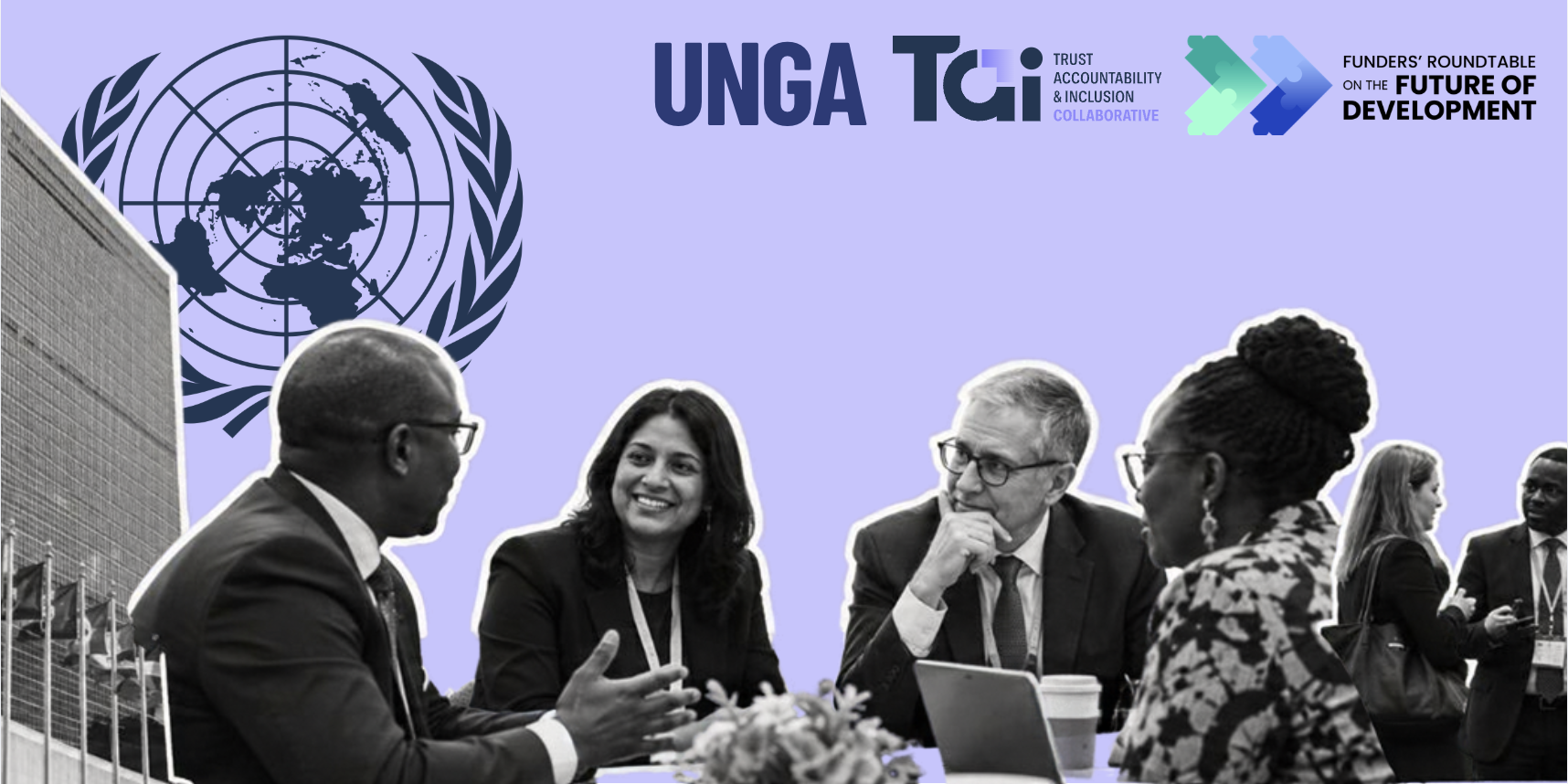
Across the conversations the Funders’ Roundtable held during UNGA week, one message resonated above all: Global South leadership is taking center stage.
At the Accra Reset Full Circle event, President Mahama of Ghana put it plainly: “There is no ownership without control, and no sovereignty without domestic accountability.” Throughout the week, we heard calls to leverage Global South and diaspora capital, strengthen civil society, and turn high-level ambition into tangible results for local communities.
Yet participants surfaced an important distinction: being present in a conversation is not the same as having the power to shape it, or the resources and decision-making authority to act.
Our data points to a similar tension. For several months, we have been mapping initiatives shaping the future of development, building a living picture of where new approaches are emerging and who is leading them. Of the 128 initiatives identified so far, only 26 are led from the Global South. So what would it take to shift not just the conversation, but who has the power to shape the system?
That question was at the heart of our September 23 Multi-Stakeholder Session, The Future is Here – Embedding New Approaches to Development. The examples showed that alternatives are not theoretical.
Myrna Cunningham of Pawanka Fund spoke about Indigenous self-determination and self-financing. Khushboo Awasthi of ShikshaLokam showed how “micro-improvements” can enable communities to identify and solve problems themselves. Almaz Negash of African Diaspora Network challenged us to think “beyond remittances”, unlocking diaspora capital, talent and time.
Participants also offered practical suggestions: back experts on the ground; fund organizations, leaders and movements, not only projects; and invest in the ecosystems and “connective tissue” that enable collective action. One suggestion captured the shift particularly clearly: “Choose not to hold the power. Act as an enabler and then step back.”
The question after UNGA is not whether new approaches exist. They do. It is how philanthropy can help create the conditions for them to grow, bringing its resources, networks and convening power while making more space for those closest to the challenges to determine what comes next.
Crucially, this means helping to operationalize visions like the Accra Reset so that high-level commitments deliver real, accountable results for communities.