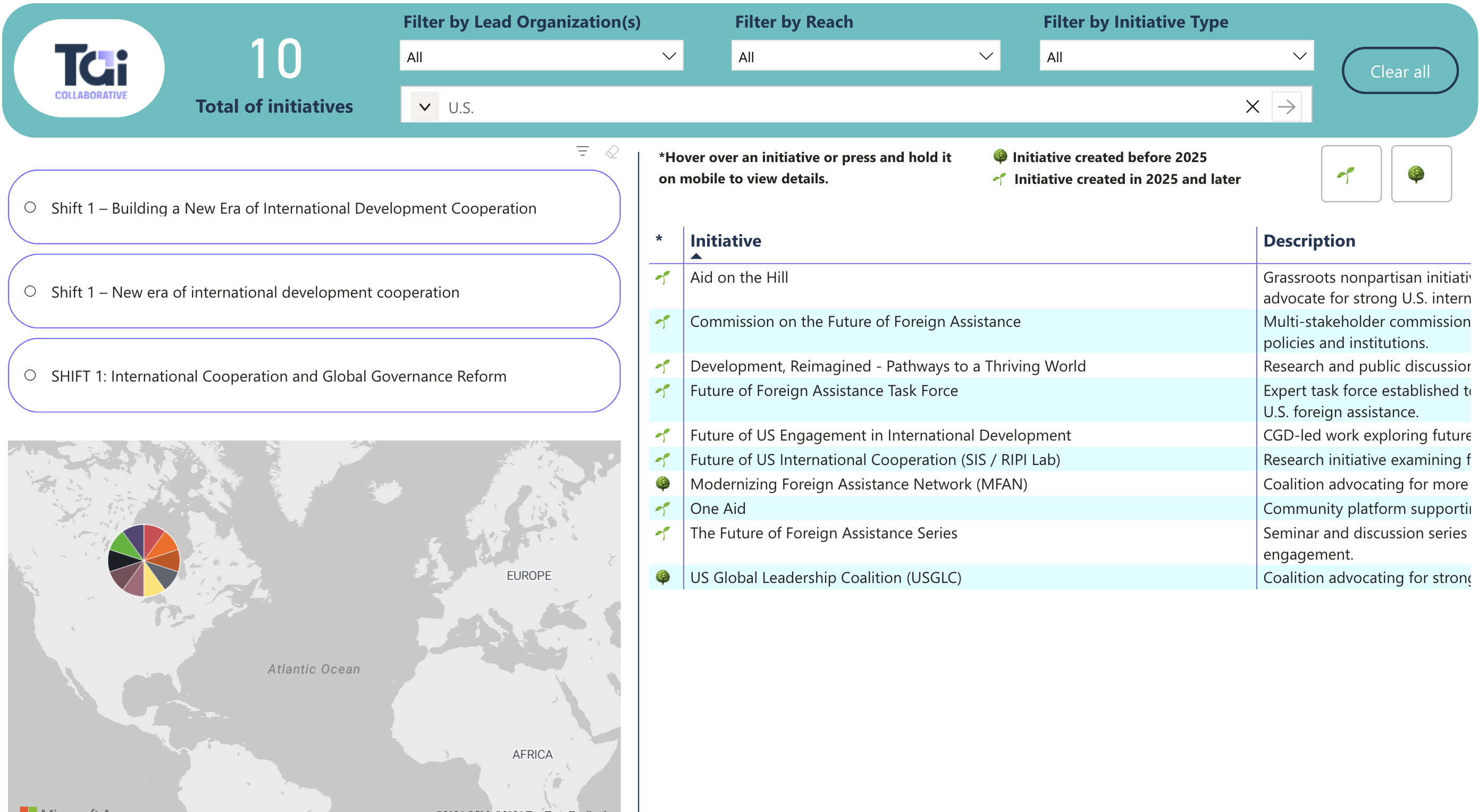
Over the past few months, we have been mapping the evolving landscape of initiatives exploring the future of development. Our live inventory now tracks more than 100 initiatives spanning the four shifts framing adopted by Roundtable members. The mapping is designed as a living resource to help members spot emerging trends, identify potential partners, and avoid duplication. You can explore the full interactive inventory here.
One clear strand of activity is the evolving ecosystem of initiatives exploring what comes next for U.S. foreign assistance.
By the numbers
120 initiatives mapped
59 have been launched since 2025
6 regions of origin represented
15 focused more specifically on the future of U.S. foreign assistance
10 related initiatives exploring aid transition, localisation, and new models of development cooperation.
Rather than advocating to simply re-create USAID or defend past institutional structures, individuals, organizations, and philanthropies are asking more fundamental questions about how U.S. cooperation should operate in an era of geopolitical fragmentation, fiscal pressure, and growing calls for locally led development.
Four Key Trends on the Future of U.S. Aid Mapping
As conversations around the future of U.S. foreign assistance gain steam, we see four trends emerging:
Protecting Hard-Won Lessons While Building Something New
The aid sector is trying to do two things at once: save valuable institutional knowledge and be open to more radical redesign for what comes next. Groups like the USAID Knowledge Rescue Initiative, the Aid Transition Alliance, and OneAid are racing to preserve decades of technical data and keep experienced talent connected as the sector shifts. Plus, ideas and pressure are being mobilized to increase the chances that existing Congressional allocations for development are spent and spent well. At the same time, efforts like the new Commission on the Future of Foreign Assistance (led by Gov. David Beasley and Sen. Ben Cardin), the Columbia SIPA / Baker Institute Task Force, and SID-US are taking a fresh look at the system to rethink and modernize it for the years ahead.
Shifting from "Aid" to Economic Partnership
Foreign assistance is framed more explicitly than ever around mutual benefit - aligning to U.S. national security, economic resilience, and strategic competition. Policy hubs and advocacy platforms such as CSIS, CGD, and Aid on the Hill are considering the links to economic statecraft; there is more attention to blended finance, private capital mobilization, and sustainable economic partnerships involving U.S. actors.
Rebuilding Public and Political Trust
Almost every initiative agrees that foreign assistance cannot survive without strong, bipartisan support back home. Coalitions like the US Global Leadership Coalition and the Modernizing Foreign Assistance Network are pushing for radical transparency and clear metrics to show American taxpayers and lawmakers a clear return on investment. Building on some positive polling data on U.S. public attitudes to foreign assistance, there is potential for a mix of leaders across the political spectrum to lay out a vision of U.S. assistance that need not be at the mercy of every election cycle.
Imagining Decision-Making Closer to the Ground
There has been much criticism of a delivery model reliant on large DC-based contractors, even though much remaining assistance still flows through those channels. Initiatives from Harvard Kennedy School CID and Georgetown SFS, alongside networks such as Aid Transition Alliance, are fostering the dialogue around passing real funding and decision-making power directly to local organizations on the ground. The goal is a more flexible, agile system that can respond quickly to local priorities instead of getting stuck in slow, rigid bureaucracy.
The mapping also reveals important gaps and tensions. While this emerging ecosystem is generating valuable ideas, these conversations remain heavily Washington DC-centric—risking blueprints designed for partner nations rather than with them. Moreover, while high-level policy papers offer big-picture vision, equal priority must be given to developing actionable plans that tackle operational bottlenecks, such as overhauling procurement rules and compliance systems so money can reach local partners without multi-year delays. Underpinning all of this is an unresolved ideological tension: can foreign assistance prioritize national security and economic self-interest while remaining value-based and driven by country-led priorities?
Aligning U.S. Reform with Global Shifts
U.S. foreign assistance reform does not and should not happen in a vacuum. Rather than treating it as a standalone agenda, we must connect U.S.-focused initiatives with the larger transformations reshaping international cooperation globally.
By bringing efforts like the Commission on the Future of US Foreign Assistance into direct dialogue with Global South-led agendas, such as the Accra Reset, we might help bridge the gap between Washington policy circles, philanthropic funders, and proximate leaders on the ground. This approach aims to foster alignment where there is currently fragmentation and help philanthropy mobilize flexible capital to test and scale new development models.