Dear partners,
Welcome to the October newsletter!
This edition is particularly rich in data, from the latest reports to more qualitative perspectives on how to assess meaningful change. And we turn that lens on ourselves, too, taking stock of the Roundtable and member actions, and gearing up for an ambitious pipeline of activities ahead.
Many Roundtable funders were active in Bangkok for the International Monetary Fund (IMF) and World Bank Annual Meetings. Notable announcements included participation in the launch of the World Bank’s Philanthropy Hub, a new platform with the intended goal of combining capital, knowledge, and networks, the release of the impressive Development Finance Observatory, and a call from the Rockefeller Foundation for a Growth and Investment Reset - a surge of financing from the IMF and World Bank, matched by a G20 commitment to stop drawing money back out, for countries that commit to ambitious investment and reform plans. Read on to hear the take of Gary Foster, CEO of Publish What You Fund, on perhaps the dominant topic in Bangkok – private capital mobilization.
We hope this month's research, evidence, and perspectives spark a few questions for you.
Soheila and the Roundtable Team
Roundtable Latest
Over the past few weeks, we noticed the conversations funders are having about the future of development across different forums are increasingly connected.
Fresh off UNGA meetings, we headed to the WINGS Forum in Montréal to host nearly 40 global foundation and regional network leaders for a dinner on the future of local resourcing. The conversation highlighted that we must invest directly in local philanthropic infrastructure, give communities a greater say over how funding is used, and build tighter connections between the Roundtable and local philanthropy.
From there, Soheila joined the Philea’s Funders in International Development (FIND) annual meeting. It was striking how closely European funders’ discussions—on shifting power, unlocking capital, and partnering with institutional donors—mirror those in the Roundtable. More details on collaboration to come soon.
The secretariat was also invited to the OECD Development Finance Data Forum on tracking funding for locally led development (LLD). Development Assistance Committee members were urged to uphold their LLD commitments and measure official development assistance directly reaching local entities. But the discussion went further, highlighting that true local ownership isn’t just about routing more money locally: it requires shifting real decision-making power, agency, and governance to local actors.
If there's one takeaway from all three events, it's that locally led development requires building local infrastructure, aligning funder networks, and shifting real decision-making power to local actors.
What’s Emerging Across the Field: Insights on the Four Shifts
Shift 1: Building a New Era of Development Cooperation
Brazil's President Luiz Inácio Lula da Silva, European Council President António Costa, Kenya's President William Ruto, and Canadian Prime Minister Mark Carney have joined forces to defend multilateralism. In a joint Financial Times opinion piece, they argue that international cooperation is not a matter of idealism, but a necessity for tackling challenges that no country can address alone.
What would those who worked inside USAID have done differently? Drawing on a survey of former agency staff, Paul Weisenfeld of the Center for Global Development explores lessons for the future of US foreign assistance, from clearer priorities and greater flexibility to a deeper understanding of local ownership.
This piece in The Guardian examines the triple threat of an energy crisis, El Niño natural climate phenomenon, and rising borrowing costs facing developing economies. The United Nations Development Programme warns that these combined pressures could push tens, if not hundreds, of millions back into poverty, calling for urgent international action and greater access to affordable finance.
How multilateralist is China? Beata Cichocka and Ian Mitchell note how deepened its presence in traditional multilateral development banks and UN bodies—doubling its funding to $3 billion—becoming a major source of concessional and climate finance, although not yet with a proportional increase in voting share or leadership representation.
Shift 2: Remodeling Development Finance Flows
In this conversation from Devex's The Next Frontier series, Kate Hampton of the Children's Investment Fund Foundation joins Angeline Murimirwa, CEO of the Campaign for Female Education, and Sam Koojo of Uganda's Ministry of Finance to explore a different approach to development financing, one that places local agency, state capacity, and community commitment at the centre of sustainable growth.
Nearly US$900 billion in global remittances, up 22% since 2020. New data from the Center for Global Development reveal the growing importance of migrant transfers as aid budgets shrink, while highlighting an uneven geography: countries with limited access to higher-income migration destinations are less able to benefit from these flows.
For every US$1 in pre-arranged crisis finance paid out by the World Bank's International Development Association, US$9 was committed after disasters had already struck between 2018 and 2025. A new report from the Centre for Disaster Protection makes the case for expanding financing agreed in advance, alongside the preparedness needed to make it effective. This ties to a recent TAI Collaborative exploration of how climate resilience is also a governance challenge requiring stronger local leadership, trust, and community capacity long before disasters strike.
Eight civil society networks and organizations came together to release a new report challenging what they term a "failed experiment" around mobilizing private capital for development born of a "blind faith in private finance as a catch-all solution to fund the SDGs and climate action." The authors call for rebalancing the role of public and private finance.
Shift 3: Strengthening Locally-Led Development
Across 33 countries, social purpose organizations share the challenges they face and what it takes to sustain their work with communities. Explore their experiences and insights in the 2026 World Giving Report's Charity Insights.
As climate disasters intensify and aid budgets shrink, climate-vulnerable countries are taking the lead in shaping their own responses. Through a new South-South cooperation pledge, members of the Climate Vulnerable Forum and V20 aim to strengthen collaboration among countries facing similar challenges, drawing on their own priorities, knowledge, and experiences.
What role can the African diaspora play in shaping the future of philanthropy between the US and Africa? This piece in Alliance Magazine explores the diaspora's potential contribution to philanthropic relationships and approaches that better reflect African perspectives and priorities.
Accountability Lab maps the organizational, financial and relational foundations of civic resilience, finding a common thread across proposed solutions: the need to connect what currently operates in silos.
Shift 4: Improving Philanthropic Collaboration
A new report from the Commission on Asian Philanthropy looks ahead to 2050, exploring how stronger philanthropic ecosystems across Asia could mobilize local resources, strengthen institutions, and support more inclusive and sustainable development.
More than 300 examples of philanthropy working together! Explore the updated Philanthropic Collaborations Database from the Bridgespan Group, developed in collaboration with the Gates Foundation, to discover the different ways funders around the world are pooling resources, aligning priorities, and working towards shared goals.
A five-year, US$30 million partnership between the LEGO Foundation and Co-Impact aims to improve learning and well-being for 2.5 million children in Kenya and Nigeria. Devex takes a closer look at how flexible funding, shared expertise, and support for locally led organizations are shaping this collaboration.
Project resource optimization has helped mobilize more than US$170 million for over 100 projects across 40 countries. This Inside Philanthropy article looks at how the initiative is drawing new donors into global development and connecting funding with projects seeking support.
HIGHLIGHT
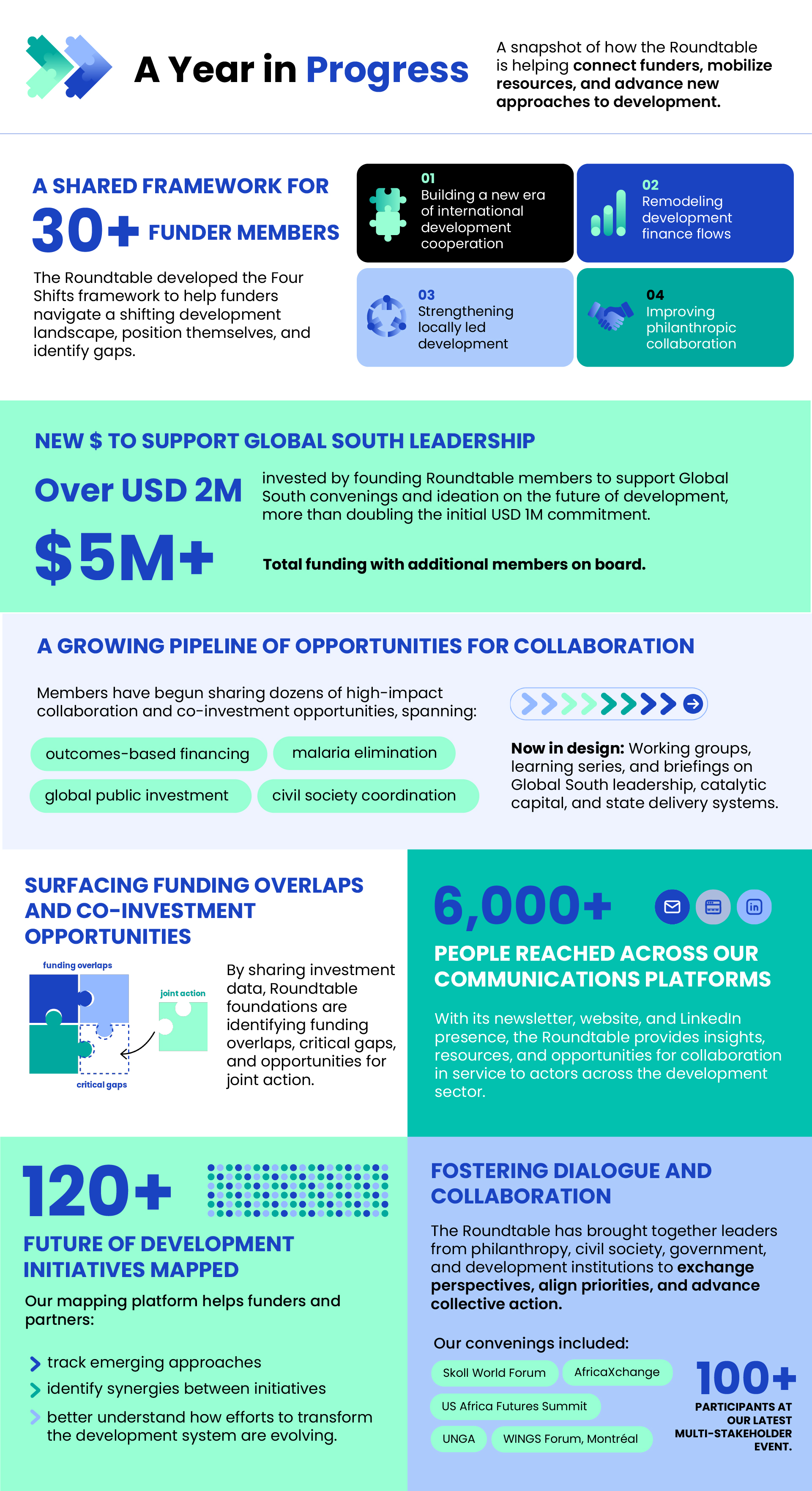
As the year draws to a close, we're taking stock of how the Roundtable's conversations and connections are translating into action. Here are a few snapshots of that progress.
Deep Dive: Mobilising more private capital, but are we measuring what matters?
by Gary Foster, CEO of Publish What You Fund
“I can mobilise more private capital, but you’ll get less impact.” That was the candid view of a European DFI CEO I spoke with at the World Bank annual meetings, and it captures the central challenge facing development finance right now.
Private capital mobilisation (PCM) was the dominant theme of the meetings. The World Bank arrived with record figures, $112 billion mobilised in FY26, triple the level of four years ago. The message from the podium was to do more, faster. Far less was said about what all that capital is achieving.
The warning signs are there. PCM in low-income countries has stagnated, and the latest MDB Joint Report showed a fall of roughly 35% on the previous year. Capital flows most easily to middle-income markets, which is where MDB investment is likely to be least additional.
The problem is that we can’t properly verify or track any of this. The International Finance Corporation (IFC) accounts for most of the World Bank Group’s mobilisation, yet it doesn’t disclose disaggregated PCM data, so we can't see which deals are mobilising finance, in which countries or sectors. Impact data is patchy, and clients choose which indicators to disclose. Despite all the talk of jobs, the World Bank Scorecard’s jobs indicator still has no methodology, two and a half years after launch. And we can’t see how deals are priced or how much subsidy they carry.
Meanwhile, we risk sleepwalking into treating the release of aggregated, anonymised data, often agreed under NDAs, as transparency. Initiatives like the GEMs risk database deserve real credit for getting data into the open, but aggregate statistics on public finance are not the same as accountability.
This matters directly to philanthropy. Funders are increasingly asked to derisk or subsidise DFI and MDB investments with no meaningful insight into the deal or its impact. As one observer put it to me, “the single worst use of philanthropic funding is to derisk an MDB so it can keep its AAA rating.” Funders have real leverage here: concessional capital should come with disclosure of pricing, subsidy and expected impact.
Finally, we need to look beyond the institutions themselves. The real test of mobilisation is whether institutional investors eventually enter these markets without MDB or DFI support. At present, there is no systematic way of tracking that.
Shifting the conversation from dollars and ratios to impact starts with better data.
For further reading on this subject, please see Paul James’s blog, Scale dominated the World Bank annual meetings – but where was the evidence of impact?
Events of Interest
SOCAP26 (Unlock the power of markets for impact) - Chicago - 12-14 October
World Bank/IMF Annual Meetings - Bangkok - 12-18 October
Gulf Philanthropy Forum - Abu Dhabi - 15 October
Africa Philanthropy Forum - Cape Town - 25-27 October
Sankalp Forum (Empowering Global South entrepreneurs) - Lucknow (India) - 27-28 October
World Business Forum - WOBI - 4-5 November
AVPA Conference - Cape Town - 9-11 November
Paris Peace Forum - Paris - 10-11 November
Global exChange Summit - Johannesburg - 16-18 November
Africa Philanthropy Day 2026 (APD4, OECD/AU) - Paris, 25 November
27th Jacques Polak Annual Research Conference - DC - 12-13 November
#ShiftThePower Global Summit - Kathmandu - 2-4 December
Redefining Global Trust. Doha Forum 2026 - Doha - 5-6 December